


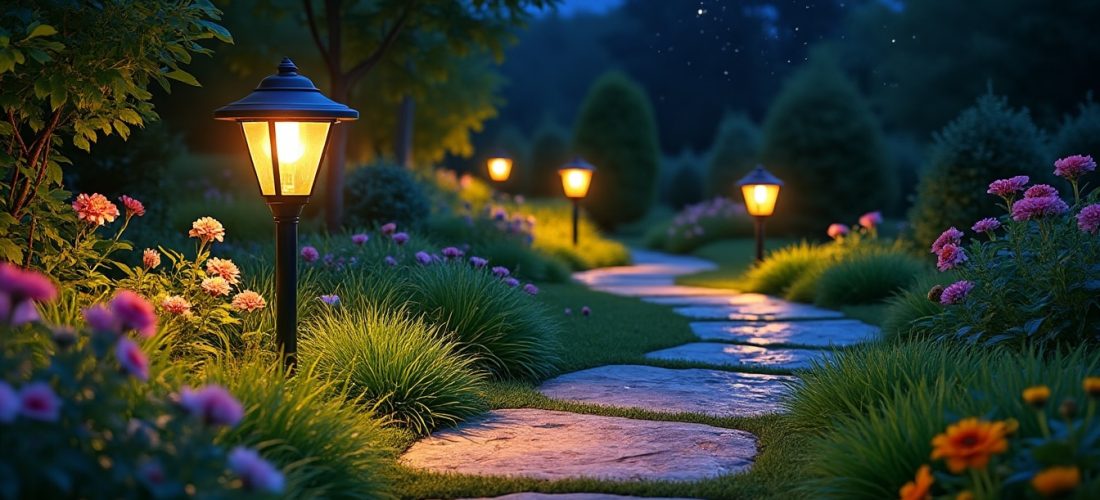
Solar LED lamps provide autonomous outdoor lighting that conserves energy while guiding movement at night. They combine simple installation, low running costs and ecological benefits for garden owners.
This practical guide focuses on choosing and placing solar lamps to secure garden allées and outdoor routes after dark. Read the concise essentials that follow in the next quick summary.
A retenir :
- Autonomous lighting for garden paths and dark areas
- Durable LED, low consumption, extended service life benefits
- Improved nighttime safety without grid energy cost for households
- Smart functions, dimmable, USB hybrid recharge available
Luminosity and autonomy for garden path solar lamps
Following the summary, choosing the right lumens determines visibility and user safety along paths. According to ADEME, selecting LED efficiency and a quality battery maximizes long term performance. Proper lumen choice also defines spacing and installation needs for effective placement.
Type of lamp Lumens Typical autonomy Recommended use Balise / Bollard 100–300 lm 6–8 hours Allées, path guidance Adjustable spot 300–500 lm 8–12 hours Accent on massifs or focal points Solar floodlight 500 lm and more Variable by panel size Security, entrances and driveways Decorative string lights ≈100 lm 6–10 hours Terrace ambience and low-level balisage
Choosing lumens for safe balisage
This section links lumens to specific path widths and expected visibility distances. Aiming for 100 to 300 lumens on linear balises avoids glare while ensuring steady guidance. For access points or work areas, choose 300 lumens or higher to aid recognition and safety.
Luminosity benchmarks for paths:
- 100–300 lm for narrow pedestrian paths and subtle guidance
- 300–500 lm for wider access points and step highlighting
- 500 lm plus for security lighting near gates and driveways
- ≈100 lm decorative strings for terraces and ambient zones
Batteries and autonomy choices
Batteries determine how long a lamp stays lit each night and how seasons affect output. According to consumer tests, lithium-ion cells offer the best compromise for capacity and cycle life. That choice influences where to place lamps to maximize sun exposure for daily recharge.
« I installed solar bollards along my path and I no longer stumble when returning late. »
Alice D.
Placement and installation strategies for garden pathways
With battery and lumen decisions settled, correct placement optimizes daylight charging and nightly coverage. According to product tests, spacing, tilt, and obstruction avoidance strongly impact autonomy and brightness. A deliberate placement strategy also eases integration of motion sensors and dimming functions.
Recommended placements for garden paths
Start by mapping the path and marking entry points and hazard locations for prioritization. Place bollards along edges and brighter spots at gates or steps to reduce falls. Avoid shaded zones that limit panel charging during crucial daytime hours.
Strategic lighting locations:
- Path edges for continuous visual guidance along routes
- Entrances and steps with brighter fixtures for safe access
- Near massifs for aesthetic highlighting and orientation
- Avoid heavy shade that reduces panel efficiency markedly
« Since I fitted lights with motion sensors, I come home without fumbling or stress. »
Marc T.
Orientation and anchoring for durability
Orientation toward the sun and secure anchoring protect both recharge efficiency and physical stability. An inclination toward south or the least shaded exposure enhances daily energy harvest during winter months. Solid fixation reduces maintenance and supports integration of intelligent sensors and hybrid recharging.
Installation steps overview:
- Define path layout and mark positions at regular spacing
- Verify panel exposure before fixing each lamp securely
- Set tilt for maximal daily solar capture, avoid north-facing placements
- Test night coverage and adjust spacing to eliminate dark spots
Smart functions, maintenance and long term durability for exterior solar lamps
After placement, smart functions control consumption to extend nightly lighting while preserving battery health. According to the International Energy Agency, efficient LEDs and adaptive modes multiply overall system usefulness. Maintaining panels and replacing aging cells complete a long lasting and safe outdoor installation.
Smart modes and hybrid charging options
Smart modes like dimming and motion detection reduce draw and improve night coverage when needed. Recharge via USB provides backup charging during extended cloudy periods for reliable operation. Choosing regulation and battery chemistry determines longevity and replacement intervals.
Function Impact on autonomy Recommended use Mode dimmable Reduces consumption, increases nightly duration Extended balisage in cold seasons Adaptive regulation 365 Optimizes output by battery state Continuous lighting across varied seasons USB hybrid recharge Backup energy when solar insufficient Zones with limited sunlight or during storms Motion detector On-demand illumination, energy saving Access points and security-sensitive areas
Available smart options:
- Dimming schedules to balance visibility and battery life
- Motion activation to preserve charge and heighten safety
- USB charging port for emergency top-up recharge
- Remote or app control for scene programming and diagnostics
« The neighbor noticed a clear reduction in incidents on his terrace after the lights were installed. »
Sophie L.
Maintenance, battery replacement and safety
Regular cleaning and biannual battery checks preserve panel efficiency and keep light output consistent. According to ADEME, replacing NiMH cells with lithium-ion revitalizes performance and extends useful lifespan. Good maintenance lowers cost and sustains the security benefits of well lit paths.
Maintenance practical tips:
- Clean solar panels monthly to remove dust and debris
- Check battery condition every six months and log performance
- Store or protect non frost-rated models during severe winter spells
- Replace aging cells with lithium-ion for restored capacity
« Installing lamps transformed the night in our path, the walk became safe and calming. »
Anne M.
Source : ADEME, « Éclairage extérieur et efficacité énergétique », ADEME, 2024 ; Agence internationale de l’énergie, « Trends in Lighting », 2023.


